What this site is for
Blues Warrior publishes the part of this music that belongs to no single instrument: the blues as a form you can count and a feel you have to hear. The seats in a blues band and what each carries, the chords and scales the two strung seats need, and — as the site grows — a bar-by-bar reading of where the blue notes land against each chord of a declared blues form.
The other side of that bargain is that this site will never teach you to play. It says the bass line moves with each change of chord; it does not put your hand anywhere. That is deliberate, and this page is the missing half of the deal — where the playing itself is taught, and where the neighbouring subjects live.
Where each subject is taught
 String WarriorThe same chord drawn on twenty-odd instruments at once — worth opening the day somebody hands you an instrument this site never sections and says the blues is in A.
 Theory WarriorThis site says a blues rests on dominant seventh chords; that one explains why a dominant seventh wants to move at all, from the intervals up, with no genre attached.
 Keys WarriorEvery blues piano part on this site is described in prose. That site draws the keyboard itself — the chords and scales under the rolling left hand, on every keyboard it models.
 Ukulele WarriorNot a seat in any blues band this site describes, but the blues scale fits four nylon strings too, and that site is where the chords and scales for them live.
 Bass WarriorHere the bass is one seat with one job under each bar. There it is the whole subject: technique, tunings, every bass in the family and the lines that move between chords.
 Mandolin WarriorThe mandolin sat in plenty of early string-band blues before the electric guitar took its place; that site is the instrument's deep home, chords and tremolo and all.
 Guitar WarriorThe guitar seat here is described by what it carries through a bar; the shapes, the technique and every guitar in the family — resonator included — are taught there.
 Banjo WarriorThe banjo was in African American music long before the blues had a name; that site covers every banjo in the family, its tunings and its right hand in depth.
 Fiddle WarriorThe fiddle is older in the blues than most people guess, from string bands to swing; that site teaches the bowing and the positions a sliding note needs on a fretless neck.
 Ear WarriorThe blues is learned by ear, and the first skill it asks for is hearing the chord move under you. That site drills exactly that recognition, one interval at a time.
 Bluegrass WarriorA string-band tradition from much of the same ground, and the clearest boundary to draw: that site is the band as a working room, this one the form a blues repeats and the notes that bend against it.
 Music Warrior NetworkThe map of every sister, for the reader who came for the blues and now wants the site that owns an instrument this one never gives a section.
 Nashville WarriorA blues chord sequence is short enough to learn by ear in one pass; that site is for writing any sequence down as a chart a whole session can read in any key.
 Mariachi WarriorA tradition with its own sung forms and no drummer, where a whole section strikes each chord together — worth reading beside the blues to hear how differently a band can share a pulse.
 Jazz WarriorJazz took the blues form and kept editing it. That site declares its own versions and the alterations players make to them; this one stays with the blues before the edits.
 Country WarriorCountry and the blues share three-chord ground and a good deal of history. That site is the song's parts and who plays what on a record; this one is the blues form and its bent notes.
 Tres WarriorA music built on a short figure repeated over a steady cycle, much as a blues riff is — but Cuban, and riding a rhythm that works nothing like a shuffle.
 Sitar WarriorThe bent note is the centre of that music too: a sitar player pulls the string sideways across the fret to reach pitches between the frets, the same idea a blues guitarist bends toward.
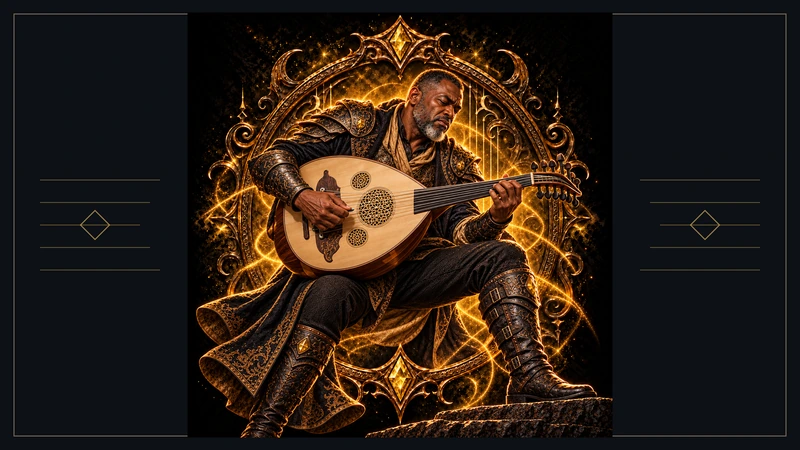 Oud WarriorNo frets at all, so every in-between pitch a blues player has to bend toward is simply there under the finger — a useful ear check on what a blue note really is.
 Cuatro WarriorAnother countryside tradition with its own lead instrument and its own sung forms, and a reminder that the blues is one rural music among many rather than the only one.
 Charango WarriorA small instrument that carries a whole tradition's rhythm in the strumming hand, written down stroke by stroke — the opposite of the blues, where the feel is almost never written.
 Cavaquinho WarriorSamba and choro run on a pulse as particular as the shuffle, and that site writes down the strumming hand behind it completely instead of leaving it to feel.
 Gear WarriorBlues players care about amps and strings more than most — which amp, which gauge, who makes it now — and that is the whole subject over there.
 Flamenco WarriorThe blues repeats a form of bars; flamenco repeats a cycle of counts. That site lays out four palos that way, twelve counts each, and says which accents a count in twos or in threes explains.
 Progression WarriorThis site reads a blues one bar at a time against a form it already knows. That site takes a chord line that follows no known form and works out the key and the moves from the symbols alone.
 Pedal Steel WarriorSlide blues is played with a bar on a guitar held the usual way. That site follows the bar onto the lap steel and the pedal steel, where the instrument lies flat and the pedals retune strings under it.
 Scales WarriorThe blues scale has six notes, which keeps it out of that site's atlas. That site maps the seven-note scales around it: Mixolydian and Dorian among 49 modes, each linked to the ones a single altered degree away.
 Music Warrior AIAsk an AI assistant to move a twelve-bar into another key and it may guess. That site is an endpoint it can call instead: it transposes the whole progression in one call, then gives each chord's voicings on the instrument in hand with the page they came from.
How the network divides the work
One family, one home. The guitar and the bass this site sections each have a sister that owns the whole family outright, and every chord and scale page here carries the door to it; nothing is taught twice. The genre sites divide the same way, by subject rather than by instrument: a jazz tune, a country record's parts, a bluegrass band's working room and a session chart each have their own home, and this one keeps to the blues.
Sisters still being built are not in the list above; each joins it the day it opens. The piano's part in a blues band is described on this site's own instruments page, which links onward to the keyboard site itself.